
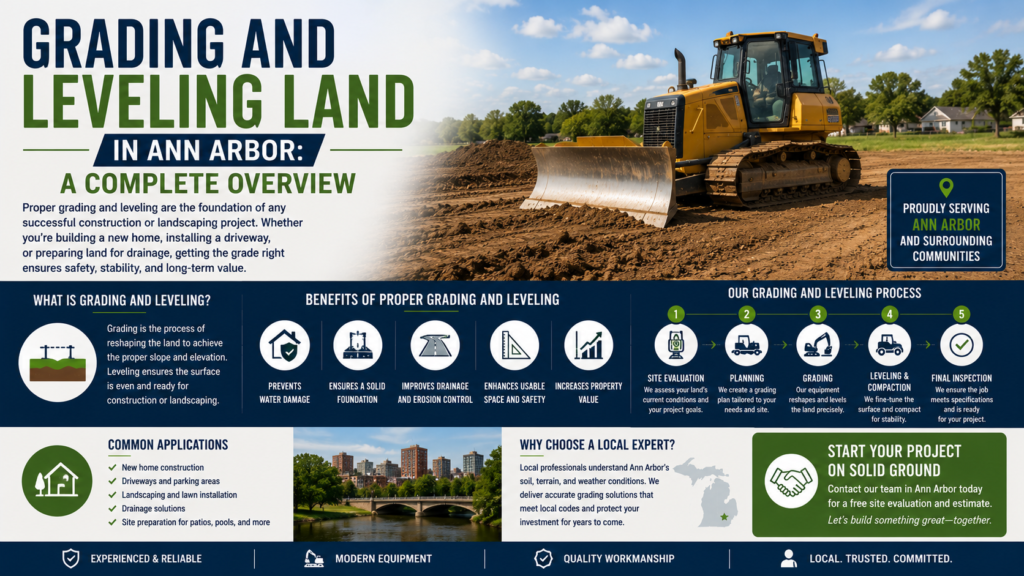
Grading and leveling are two related but distinct land preparation techniques used in construction, landscaping, and site development. Both processes involve reshaping the topography of a piece of land, but each serves a different purpose.
Land leveling aims to create a uniformly flat and even surface. It is often used in agricultural settings or when establishing foundations that require a consistent elevation. The process typically involves cutting down high spots and filling in low areas until a stable, uniform grade is achieved.
Land grading, on the other hand, focuses on shaping the land into deliberate contours and slopes according to an engineering or design plan. Rather than simply making the land flat, grading directs how water flows across the surface. A properly graded site channels stormwater away from structures, prevents soil erosion, and creates a stable base for construction.
In Ann Arbor, Michigan, where seasonal rainfall, snowmelt, and the area’s unique soil conditions can create drainage challenges, professional Grading And Leveling Ann Arbor services are a critical component of many residential and commercial projects.
Why Proper Grading Matters
The importance of grading and leveling extends far beyond aesthetics. Buildings constructed on improperly graded land can develop serious structural problems over time. When the ground around a structure is not adequately sloped to direct water away, moisture accumulates near the foundation. This can lead to basement flooding, cracked foundations, and soil erosion that undermines the building’s support.
In Ann Arbor, the combination of clay-heavy soils and seasonal precipitation makes drainage planning especially important. Homes and commercial properties that experience repeated pooling water, wet basements, or erosion channels in the yard are often dealing with inadequate grading. Corrective grading known as regrading redirects surface water to appropriate drainage points, providing long-term protection for the property.
The Grading and Leveling Process
A grading or leveling project begins with a thorough site assessment. This includes measuring the existing topography, evaluating soil conditions, and identifying any underground utilities or obstacles. From this evaluation, a grading plan is developed that specifies the desired final elevations and the slope needed to achieve proper drainage.
Next comes the clearing phase, where any vegetation, debris, or obstructions are removed from the area to be graded. Depending on the scale of the project, heavy equipment such as bulldozers, front loaders, excavators, and motorized graders are brought in to move and redistribute soil.
Rough grading reshapes the general contours of the land, cutting down high areas and building up low ones. Once the basic shape is established, drainage systems such as French drains, catch basins, or underground pipes may be installed to handle water runoff. Final grading then smooths and refines the surface, ensuring it meets the precise slope and elevation specifications of the design plan.
Soil compaction is a critical step that follows. Properly compacted soil prevents settling over time, which could otherwise cause uneven surfaces and structural instability. The project is typically completed with topsoil application and sometimes seeding or sod installation to stabilize the graded surface.
When Do Ann Arbor Properties Need Grading?
Several situations commonly require professional grading and leveling services. New construction sites almost always need grading before building begins, as establishing a stable, level foundation is essential for structural integrity. Pre-construction grading ensures that the building pad is at the correct elevation and that water will flow away from the structure once it is built.
Existing properties may also need regrading when drainage issues develop. Common warning signs include standing water in the yard after rain, soil erosion channels, water intrusion into a basement or crawl space, or foundation cracking. In Ann Arbor, where localized flooding is a known concern, correcting the grade of a yard can make a meaningful difference in protecting a home from water damage.
Additionally, grading is often required before major landscaping projects. Installing a new patio, driveway, retaining wall, or garden area typically requires the ground to be properly leveled and shaped beforehand to ensure long-term stability.
The Role of Professional Grading Contractors
While minor yard grading can sometimes be approached as a DIY project, most grading and leveling work benefits significantly from professional expertise. Licensed grading contractors understand local soil conditions, municipal drainage regulations, and best practices for soil compaction. They have access to the heavy equipment needed to efficiently reshape land at scale and can identify and address potential issues that might not be apparent to an untrained eye.
In Ann Arbor, working with experienced local professionals who are familiar with the area’s topography and stormwater management requirements can help property owners avoid costly errors and ensure that grading work meets all applicable codes and standards.